
RECHERCHE
Perception auditive du bruit de l'eau qui coule, chez l'être humain, dans un habitat naturel.
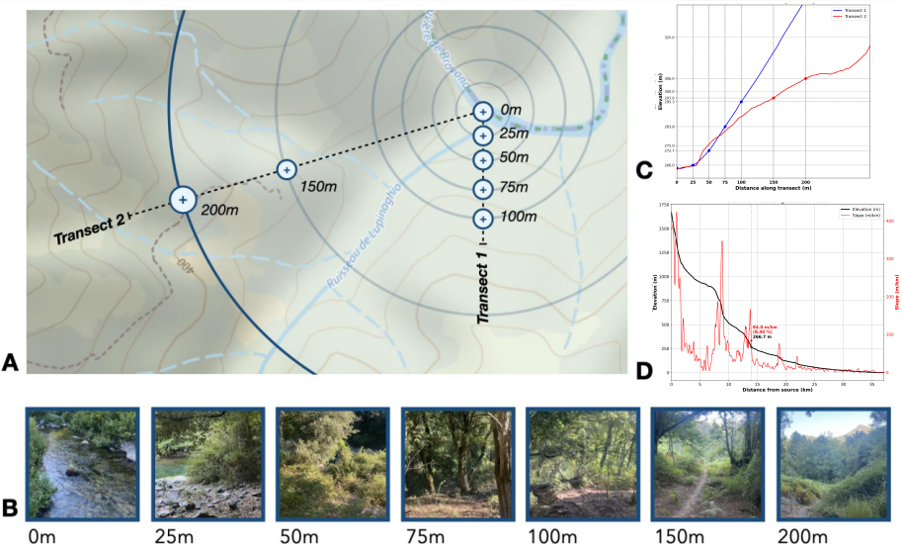
Y a-t-il un cours d’eau dans les environs ? Être capable de détecter la présence d’une rivière ou d’un fleuve à l’oreille, en l’absence d’informations visuelles pourrait vous sauver la vie si vous êtes
perdu·e en forêt de jour ou de nuit.
L’étude réalisée par Matthieu Fraticelli et Christian Lorenzi, chercheurs au Laboratoire des Systèmes Perceptifs, et Marcus Klaus, géoscientifique suédois, répond à cette question en mettant en œuvre
des expériences psychophysiques réalisées sur des participant·es adultes âgé·es entre 18 et 90 ans, combinées à des simulations informatiques de modèles du système auditif humain.
Lire l'article
Les fondements mécanistiques des biais sociaux (Projet SO-BIAS)

Le projet ANR SO-BIAS a débuté en mars 2026. Il est mené conjointement par Julie Grèzes, directrice de recherche INSERM au Laboratoire de Neurosciences Cognitives et Computationnelles à l'ENS, Lou Safra, maitresse de conférence en psychologie politique au CEVIPOF à Sciences Po, et leur doctorant·e Lucile Bottein.
L’objectif du projet SO-BIAS est d’étudier les mécanismes cognitifs impliqués dans l’expression et le contrôle des biais racistes, sexistes et intersectionnels. Ce projet a également reçu le soutien de la Fondation Lilian Thuram contre le racisme et du Défenseur des Droits.
Lire l'article
IA : Détecter le vague pour mieux voir le fake

Vagues, subjectives, difficilement réfutables… Les informations floues biaisent le débat public et laissent prospérer fake news et manipulations. Le projet de recherche TrustedNews coordonné par Paul Égré, directeur de recherche CNRS à l'Institut Jean Nicod, développe des outils numériques pour aider journalistes et expert·es à identifier et analyser ces contenus.
Lire l'article
FINANCEMENTS
Améliorer la détection et la compréhension des troubles du développement cérébral de manière précoce avec la neuroimagerie fonctionnelle par ultrasons (fUSI)

Yves Boubenec, chercheur en neurosciences au Laboratoire des Systèmes Perceptifs, a reçu un financement de la Fondation pour la Recherche Médicale pour le projet fUSI dont l'objectif est d'améliorer la détection et la compréhension des troubles du développement cérébral de manière précoce avec la neuroimagerie fonctionnelle.
Lire l'article
Comprendre les interactions entre les différentes régions du cerveau lorsque nous apprenons une nouvelle compétence motrice

Juan Luis Riquelm est chercheur post doctoral. Il vient d'obtenir une bourse du Human Frontier Science Program (HFSP) pour travailler au sein de l'équipe Neural Representations of Learning and Behavior dirigée par la chercheuse Alex Cayco Gajic. Cette équipe étudie les mécanismes de l'apprentissage tant au sein des populations neuronales que dans les réseaux artificiels. Pendant trois ans, le chercheur tentera de comprendre les interactions entre les différentes régions du cerveau lorsque nous apprenons une nouvelle compétence motrice.
Rencontre avec un scientifique animé par une soif constante d’apprendre, dont le parcours est porté par une curiosité insatiable.
DANS LES MÉDIAS
Gaspard Koenig, Gloria Origgi, Stephanie Roza, Alain Finkelkraut, faits pour s’entendre

Dans cet article de Philosophie Magazine, Gloria Origgi, Gaspard Koenig, Stéphanie Roza et Alain Finkielkraut dressent un diagnostic commun malgré leurs différences : la dégradation du débat public.
Lire l'article
Alda Mari : "Détecter les situations d'urgence sur les réseaux sociaux"

Entretien dans Science & Avenir avec la linguiste Alda Mari, lauréate de la médaille de l'innovation 2025 du CNRS pour la conception du logiciel Intact, une intelligence artificielle qui fait remonter les informations urgentes dans les réseaux sociaux lors d'une crise environnementale.
Lire l'article
Le coeur influence nos pensées !
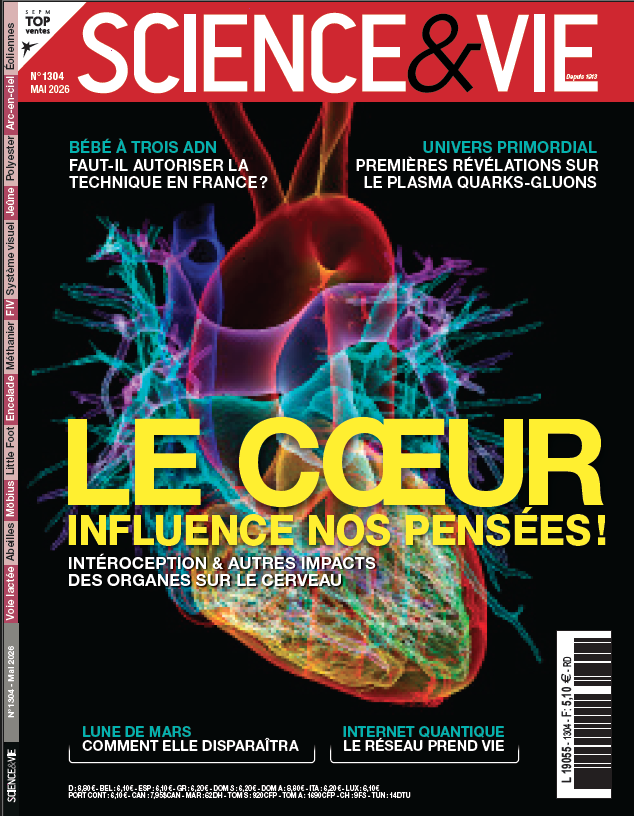
Catherine Tallon-Baudry, directrice du Laboratoire de Neurosciences Cognitives et Computationnelles, chercheuse en neurosciences spécialiste de la conscience, a participé à ce numéro spécial de Science & Vie dédié à l'interoception et à l'impact d'autres organes sur le cerveau.
Pour en savoir plus
À VOIR
L’intelligence : qu’est-ce que c’est ? Comment ça se mesure ? D’où ça sort ?
Conférence donnée par Franck Ramus, directeur de recherche CNRS au Laboratoire de Sciences Cognitives et Psycholinguistique, dans le cadre des conférences du Forum des Sciences Cognitives qui avait pour thème cette année "Intelligences: Explorer la cognition à toutes les échelles".
Notre cerveau nous joue des tours
A travers des expériences ludiques et étonnantes, Albert Moukheiber, chercheur et vulgarisateur, invite à découvrir le fonctionnement, parfois trompeur, de notre cerveau.
Avec la participation de Stefano Palminteri, chercheur au Laboratoire de Sciences Cognitives et Computationnelles et d'Hugo Mercier, chercheur à l'Institut Jean Nicod.
QUELQUES PUBLICATIONS RÉCENTES
Alain de Cheveigné (2026). Spatial Filters - In Search of the Virtual Electrode
Journal of Neuroscience, 46 (7) e0971252026.
doi:10.1523/JNEUROSCI.0971-25.2026
Résumé :
A spatial filter combines signals from multiple sensors to create a virtual channel that emphasizes specific brain activity while reducing interference. Spatial filters range from simple, fixed configurations-such as rereferencing, gradient, or Laplacian filters-to more sophisticated, data-driven approaches like beamforming or independent component analysis (ICA). Although the underlying principle is simple, understanding a spatial filter's behavior can be challenging because of the high dimensionality of the data and the multiple "spaces" involved-those of sources, sensors, fields, and signals. This paper examines the properties and limitations of spatial filters, focusing on the idea of a virtual electrode-a synthetic signal formed by combining channels from noninvasive techniques such as EEG or MEG. While a spatial filter can fully suppress some sources, it cannot perfectly isolate a single source while rejecting all others, as a real electrode could. This places clear limits on what a virtual electrode can represent. I here suggest an alternative view of it as a virtual scalpel-a tool for refining recorded data rather than capturing activity of a single neural source. Just as temporal filters shape signals over time, spatial filters are key tools for improving the clarity and interpretability of brain recordings.
Dubourg, E. & Scrivner, C. (2026). Vulnerability and the computational logic of fear: insights from the horror genre. Evolution and Human Behavior, 47(1), 106813. doi:10.1016/j.evolhumbehav.2025.106813
Résumé :
Fear is a universal feature of storytelling, yet the structural conditions that make fictional threats compelling remain poorly understood. Here, we propose the Protagonist Vulnerability Index (PVI), an evolutionarily grounded computational approach to explain why some narratives evoke stronger fear responses than others. PVI quantifies protagonist vulnerability by assessing the imbalance in formidability between protagonists and antagonists and the risk of attack faced by the protagonist. Across 691 films, higher PVI values predicted classification as horror, the presence of fear-related keywords in non-horror films, and stronger physiological fear responses indexed by heart rate. Linking film preferences to psychological and demographic data from more than 3.5 million individuals on Facebook, we found that preference for high-PVI films was associated with lower agreeableness, conscientiousness, and extraversion, and with higher openness. Openness moderated the negative association between neuroticism and engagement with fear-related content, indicating that curiosity can counteract threat avoidance in anxious individuals. These findings clarify the structural and psychological conditions that activate evolved threat-management systems. The results show how horror operates as a narrative simulation of extreme formidability asymmetry, and provide a framework for predicting, and potentially engineering, fear in fiction.
Cleret de Langavant, L., Mouton , A., de Gardelle, V., Kouider, S., Bachoud-Levi, A., Fenelon, G. & Remy, P. (2026). Visual misperceptions in favour of living beings in Parkinson's disease: A psychophysical study. Revue Neurologique.doi:10.1016/j.neurol.2025.12.005
Résumé :
Background
Parkinson's disease (PD) patients often report seeing persons or animals rather than objects but this phenomenon remains poorly understood. Here, we use three experimental tasks to confirm such observation and to explore its cognitive mechanisms.
Method
Fourteen PD patients with visual hallucinations (PD-VH), 14 PD patients without visual hallucinations (PD-NVH) and 14 controls with similar cognitive performance were tested using ambiguous stimuli. Ambiguous stimuli were morphs in which visual features from faces and flowers were melted together (Experiments 1 and 2) and a black and white picture where a Dalmatian dog was hidden (Experiment 3). In Experiment 1, participants categorised ambiguous stimuli either as face or flower. In Experiment 2, they were shown an ambiguous stimulus, then a mask, and finally two ambiguous stimuli, one of which was identical to the first stimulus. In this discrimination task, participants chose which of the two last stimuli had been presented before. In Experiment 3, participants guessed the items hidden in the picture. We assessed group differences for categorisation with logistic modelling and computed sensitivity index and criterion psychophysical measures in Experiments 1 and 2. The ratio of living beings identified in the Dalmatian dog task was compared across groups.
Results
In the categorisation task, the PD-VH group tended to use a smaller proportion of visual features (point of subjective equality [PSE] = 41.5%) to label a stimulus as Face compared to PD-NVH (51%) and controls (56.2%). In the discrimination task, criterion c was lower in the PD-VH group compared to controls (c: –0.16 vs. 0.27; P = 0.005). In the Dalmatian dog task, the PD-VH group reported seeing livings beings more frequently than controls (P = 0.040). A bias towards living beings was confirmed in the PD-VH group in the three tasks, and a bias toward non-living beings was measured in controls in the discrimination task.
Interpretation
Observing that controls exhibited bias toward non-living beings in the discrimination task, we suggest that impaired top-down control over perception processes explains the bias toward living beings in PD-VH visual misperceptions.
Miller-Viacava, N., Apoux, F., Ferriere, R., Friedman, N. R., Mullet, T. C., Sueur, J., Willie, J. & Lorenzi, C. (2026). Modulation statistics of natural soundscapes. Journal of the Acoustical Society of America, 159, 1263-1289.doi:10.1121/10.0039892
Résumé :
Modulation statistics of "natural soundscapes" were estimated by calculating the modulation power spectrum (MPS) of a database of acoustic samples recorded in nine pristine terrestrial habitats for four moments of the day and two contrasting periods, differing in precipitation level. In particular, a set of statistics estimating low-pass quality, starriness, separability, asymmetry, modulation depth, and 1/ftα temporal-modulation power-law relationships were calculated from the MPS of the samples and related to geographical, meteorological factors and diel variations. MPS were found to be generally low-pass in shape in the modulation domain with most of their modulation power restricted to low temporal (<10-20 Hz) and spectral modulations (<0.5-1 cycle/kHz). Modulation statistics were distinguished between habitats irrespective of moment of the day and precipitation period with a greater role of modulation depth and starriness. Separability and starriness were found to be related to the global biodiversity decrease from tropical to polar regions, suggesting that the lack of joint high spectral and fast temporal modulations and MPS complexity are important features that may characterise "biophony," the collective sound produced by animals in a given habitat. These findings may help guide research on monitoring auditory behaviours and underlying mechanisms expected to exploit regularities of natural scenes.
Tey KJ, Walker S, Seidl A, Scaff C, Peurey L, Kelleher BL, Havard W, Hamrick L, Grosjean P, Cychosz M, Colleran H, Casillas M, Bergelson E, Hitczenko K, Cristia A. (2026). The Development of Canonical Proportion as a Function of Community, Multilingualism, and Target Language's Syllable Complexity. J Child Lang.doi:10.1017/S0305000926100476. PMID: 41709412.
Résumé :
This study investigates the development of canonical proportion (CP), an indicator of speech development, across diverse language and environmental contexts. Using the Speech Maturity Dataset (SMD) comprising 366 children, aged 0;2-6;4, across 10 different languages and cultures, we explore the influence of multilingual exposure, language syllable complexity, and community type (industrialised, non-industrialised) on CP. We find that monolingual children display higher CP measures than their multilingual peers. In addition, CP is higher for children learning languages with simple syllable complexity than those with more complex syllables. We also find no significant differences in the CP trajectory of children from industrialised versus non-industrialised communities. Integrating these findings in the broader literature, we highlight the importance of diversifying participant samples to capture the complex relationship between language exposure, social environment, and language development.
Xiao, X., A. Cremers, C. Straboni, B. Strickland & S. Peperkamp (2026). The influence of grammatical gender on object conceptualization is weak and language-dependent. Cognitive Science.
Résumé :
Do we make gendered associations with objects whose linguistic labels have masculine/feminine grammatical gender? This question derives from the neo-Whorfian view that language shapes our conceptualizations of the world. Previous research has provided mixed answers. Here, we present three experiments where we tested for the gender effect on object conceptualization using a word association approach: a first group of participants generated adjectives for nouns referring to objects, and a second group subsequently rated those adjectives for masculinity/femininity. In Experiment 1, with native French speakers, we tested semantically related object nouns that have opposite grammatical gender (masculine vs. feminine) in French; in Experiment 2, with native French and German speakers, we tested translation equivalents having opposite grammatical gender in the two languages. Results from both experiments showed the absence of a gender effect in French, while a small gender effect was found in German. In both experiments, nouns had been presented with a gender-marked determiner. In Experiment 3, we tested a new group of German participants on the same items, which were now presented without a determiner; we again observed a small gender effect. Consistent with previous findings, we also found that people ascribe more feminine qualities to natural entities and masculine qualities to artificial entities. Taken together, we conclude that the influence of grammatical gender on object conceptualization is weak and dependent on language.
AGENDA
En juin au DEC, à l'ENS, et à PSL !
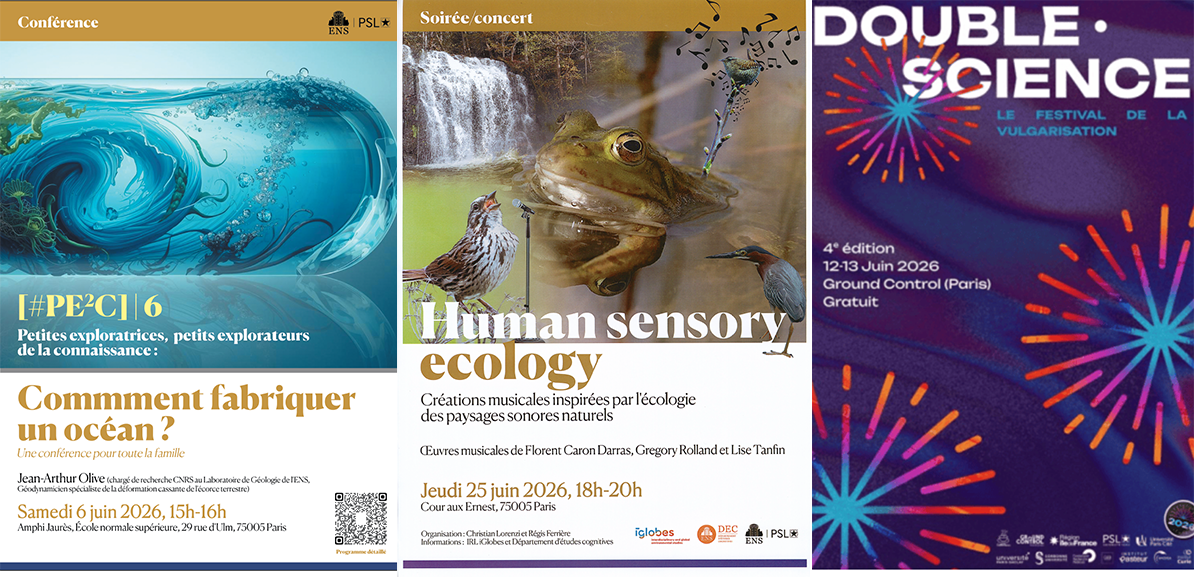
6 juin 2026 - Comment fabriquer un océan ?
[#PE²C] Petites exploratrices, petits explorateurs de la connaissance : l’École normale supérieure lance ses conférences pour les enfants
14-16 juin 2026 - Festival Double Science
25 juin 2026 - Human Sensory Ecology (Concert)
Créations musicales de Florent Caron Darras, Grégory Rolland et Lise Tanfin
Retrouvez tous les événements organisés par le DEC dans l'agenda du département et ceux de l'ENS dans l'agenda de l'école.
Les conférences et podcasts de l'ENS sont disponibles sur https://savoirs.ens.fr et sur Youtube.